

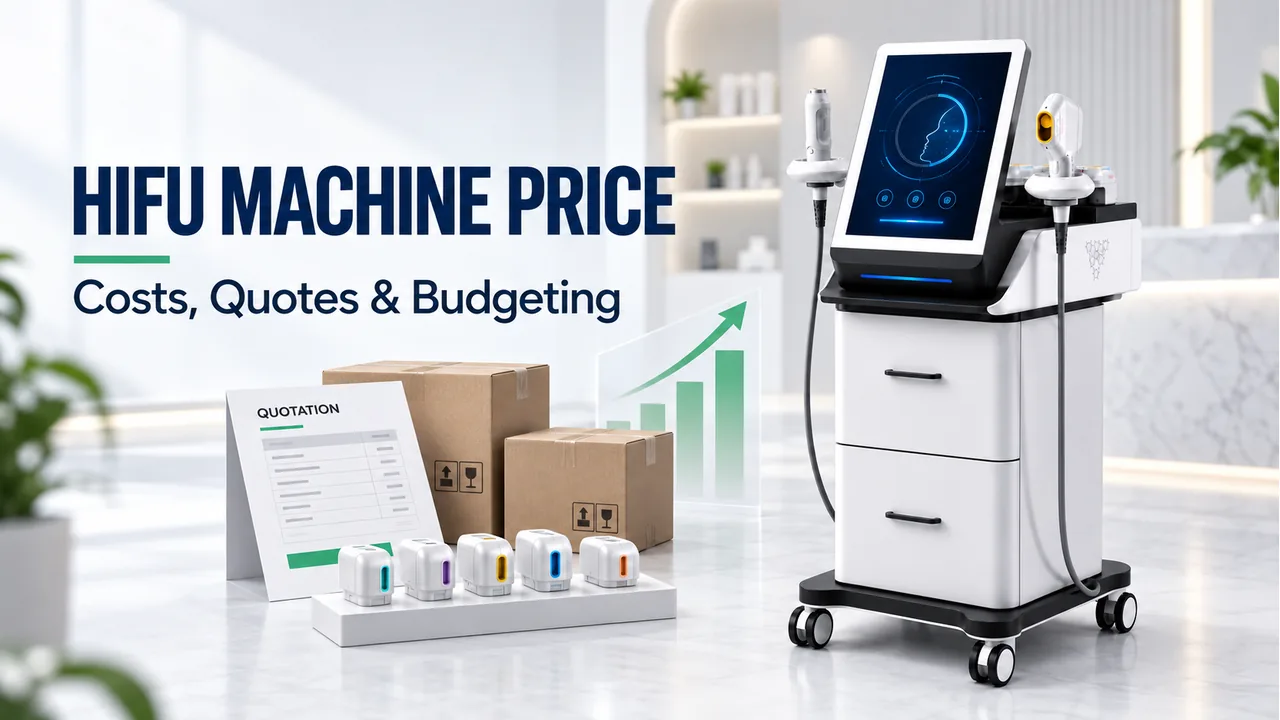
You may already have several supplier quotes in front of you. One company lists a machine for under US$2,000, another proposes a package above US$7,000, and some companies ask about your needs before sharing any price. They may all be called HIFU machines, but those figures cannot be compared side by side yet.
If this is your clinic’s first HIFU system, you need to know whether your budget will actually get the service ready to launch. If you are replacing a machine or adding treatments, you will care more about what the new system can do that your current equipment cannot. Distributors and private-label buyers also need to allow for customization, documents and after-sales support. Whatever your buying situation, start by clarifying how the price is quoted and what it includes.
Published prices for professional HIFU machines range from about US$1,789 to US$20,000. There is no single figure for a quote on request because the supplier prices the machine around the destination country, configuration, order quantity, shipping and service package. This guide puts those prices on the same budgeting basis and uses simple examples. By the end, you will be able to estimate your startup budget, ongoing costs and which quote is closest to what you actually need.
| Pricing method | What you will see | How the price is usually built | What to check first |
|---|---|---|---|
| Published price | The company displays a product price directly. It may be a base price, promotional price, package price or delivered price for a particular region. | The price can start at about US$1,789 and reach around US$20,000, depending on the machine and what is included. | Check how far the quoted price covers the console, handpieces, cartridges, shipping, training and warranty. |
| Quote on request | The company first asks about your country, planned treatments, configuration, quantity and service needs, then prepares a price for that purchase. | The machine, delivery and services are combined in one proposal. An OEM/ODM project also includes the customization scope and order quantity. | Send the same requirements to shortlisted suppliers, then compare the treatment-ready price and the total delivered investment. |
How we compare different quotes
When we help customers compare HIFU equipment, we first check exactly what each price covers, then look at the figures. Here is a clear example: one published price of US$6,332 lists the machine only, while another price of US$7,900 covers delivery to the United States or Canada, including shipping, customs clearance and duties, online training and a console warranty. The difference is only about US$1,568, yet the two offers cover different things. We recommend converting shortlisted quotes to either a treatment-ready configuration price or landed cost before deciding which one fits the budget.
If you are still comparing specific models, see Fotrohifu’s 12 HIFU machine comparison. This price guide handles the next step: turning your preferred machine into a workable purchasing budget.
Which HIFU Machine Price Are You Comparing?
Two quotes can differ by several thousand dollars simply because they cover different things. Put both figures into the four scopes below and the comparison becomes much clearer.
| Price scope | What it should include | What the buyer should ask |
|---|---|---|
| Equipment-only price | The console and the minimum components stated on the product page. | Is this one machine on its own, or is it ready for the treatments we plan to offer? |
| Treatment-ready configuration price | The console, necessary handpieces, starter cartridges, basic accessories, introductory operator training and documents needed to put the equipment into use. | Which face or body treatments can we start with this configuration? |
| Landed cost | The full configuration price plus packing, shipping, freight insurance, customs clearance, applicable duties or import taxes, local delivery and any required installation. | How much will we have paid when the equipment reaches our premises and is ready for installation? |
| Three-year total cost of ownership | Landed cost plus replacement cartridges, parts, maintenance, follow-up training, software or service fees, financing costs and a downtime reserve. | What will we keep buying after delivery, and which operating risks will we carry? |
When you see “free shipping,” ask whether duties and local delivery are included. When training is included, check whether that means recorded lessons, live online training or in-person practice. Apply the same thinking to the warranty: beyond the warranty period, find out what is covered for the handpieces and cartridges, and who pays for repair shipping.
Once you have filled in all four scopes, you are no longer looking at an isolated machine price. You have a complete budget from purchase and delivery to setup and continued use.
Why HIFU Machine Prices Vary So Much
The price of a HIFU machine is mainly shaped by its configuration, sales channel and service coverage.
1. Console and handpiece design
A basic console may offer one output mode, while another machine may have several handpieces, dot and linear modes, or extra energy and imaging functions. More functions create a more complex configuration. For a clinic, the parts worth paying for are the ones that support its treatment menu and that its operators will actually use.
Start by writing down the treatments you plan to launch. Work backward to identify the handpieces and depths you need, then check whether the new machine duplicates functions you already have. The resulting configuration will be closer to everyday operations and easier to budget for.
2. Available cartridges and included cartridges are different
A machine may support ten cartridge types while the quote includes only three, five or seven. The number available for the system and the number supplied with this order are two separate figures.
At the start of your comparison, ask whether the cartridges needed for your planned treatments are included, whether there are enough to begin operating and how much each replacement will cost. Once a machine reaches your shortlist, confirm how shots are counted and when cartridges are replaced.
A first-time facial treatment service can begin with a clearly defined starter set. If you plan to add body treatments, include the matching depths. A distributor serving different buyer types can prepare several standard packages. The cartridge count should follow the treatment plan, rather than simply being as high as possible.
3. Software, interface and operating controls
The screen, user profiles, parameter controls, shot records, interface languages and software updates also contribute to the machine cost. Ask whether software updates carry a fee and how future updates will be delivered.
Names such as “7D,” “12D” and “22D” appear in HIFU machine marketing. The name alone does not tell you how many handpieces or cartridges the machine includes or what the software does. A demonstration and configuration sheet are more useful.
4. Brand owner, distributor or factory-direct purchase
A brand-owned system may use dedicated consumables and regional service. A distributor may add local installation, training, financing or stocked parts. Buying factory-direct can offer more flexibility in configuration and branding, while requiring clear arrangements for importing and remote support.
Each channel has a different cost structure. Put freight, taxes, local compliance work and after-sales logistics into the same budget sheet to see which route fits your market.
5. OEM and private-label projects
A logo, interface language, packaging and manual are relatively basic forms of customization. Housing changes and deeper development require more work. Asking for separate prices for the standard machine and the customization project makes the budget easier to understand.
Fotrohifu separates standard brand customization, configuration changes and project-based co-development into different OEM/ODM scopes. Distributors can also place the base machine and private-label work in separate budget columns.
6. Target-market documents and responsibility
The requirements for one model can differ between countries. Before buying, give the supplier the manufacturer’s name, exact model, intended use and destination market, then ask for documents that apply to that specific machine.
In the United States, the FDA classifies aesthetic focused ultrasound stimulators under product code OHV as Class II devices using the 510(k) pathway. The FDA classification record describes the device category. To understand the market status of a particular HIFU machine, check the device record for the exact model as well.
For the European Union, refer to the EU Medical Device Regulation. Great Britain and Northern Ireland follow different routes; the MHRA market guidance explains the applicable requirements. The MHRA’s registration guidance also distinguishes registration from approval, certification, recognition and endorsement. Check the exact model against the rules for the market where it will be sold.
Five Things to Confirm in Your First HIFU Quote
Keep the first inquiry simple. Use five pieces of information to see whether the machine, budget and treatment plan fit together. Once you have a shortlist, you can complete the contract details.
| What to confirm | Why it affects the price comparison |
|---|---|
| Exact model and treatment configuration | Confirm the console, necessary handpieces and starter cartridges so you do not compare a basic equipment-only price with a complete package. |
| Total delivered to your destination | State the destination country and separate the equipment price from shipping, clearance and local delivery costs. |
| Ongoing consumables | At minimum, confirm replacement cartridge prices to see whether a low purchase price could lead to higher ongoing costs. |
| Training, warranty and repair contact | Confirm who will help your team start using the equipment after delivery and whom to contact if a problem occurs. |
| Target-market documents | The documents should match the exact model and sales market. A logo displayed on a webpage is only a starting point. |
Once these five points are clear, the first comparison is complete. Brand customization, software versions, responsibility for spare parts and detailed service terms can be added to the contract and order documents after the machine and budget have been matched.
Training Is Part of the HIFU Machine Cost
After the machine arrives, your team still needs to know how to install, maintain and operate it. The training arrangement affects how soon the equipment can go into use and what it will cost to bring new employees up to speed later.
Ask direct questions when requesting a quote: Is the training recorded, or will someone explain the equipment live and answer questions? How many operators can attend? Which channel is available if questions come up after delivery? If you need in-person training, add travel and staff time to the budget.
How we arrange equipment training
We first provide the manual and training videos, then arrange one-to-one training over Zoom. Customers can study the materials at their own pace and bring their questions to the live session. We recommend agreeing on the training format, number of attendees, time zone and follow-up support channel before ordering because these arrangements affect how the team starts using the equipment.
Cartridge Cost, Usable Shots and Cost per Treatment
Replacement cartridges are an ongoing cost. Knowing how many shots a cartridge is rated for is not enough. You also need the cartridge price and expected number of shots per treatment.
Begin with four figures: the replacement price of the matching cartridge, the shot-count rule stated in the equipment documents, the estimated usable shots after testing and setup, and the expected shots used for one completed treatment.
Cartridge cost per treatment = Replacement cartridge price ÷ Estimated usable shots × Estimated shots per completed treatmentFor example, a replacement cartridge costs US$300, provides an estimated 10,000 usable shots and uses 400 shots for one completed treatment:
US$300 ÷ 10,000 × 400 = US$12 per completed treatmentIn this example, each completed treatment carries US$12 of cartridge cost. Once you have the documents for a specific machine, replace US$300, 10,000 shots and 400 shots with the supplier’s figures to calculate your own result.
Also confirm what happens if a cartridge fails before reaching its stated shot count. A warranty based on shots, a time-based warranty and a dead-on-arrival policy cover different risks.
Budget for Warranty, Repair Shipping and Downtime
A warranty determines who pays for a repair. A downtime reserve estimates how much business could be affected while the machine is unavailable. Budget for these two items separately.
Fotrohifu’s Warranty and Protection Policy states that equipment has a one-year free warranty, while selected models may receive conditional two-year protection after confirmation. The target response time for technical support is 24 to 48 hours. The policy lists covered parts and exclusions separately. Consumables and business downtime during repairs are outside the warranty, and some replacements may also involve shipping, import or export taxes and customs clearance costs. The documents for the specific order apply.
For budgeting, focus on three questions: What is covered for the console, handpieces and cartridges? Who pays for parts, labor and cross-border shipping? Which channel starts the diagnosis when a problem occurs? Other exclusions and the warranty start date can be confirmed in the order documents.
How we follow up after delivery
In another customer project, we provided a manual, consultation form, instructional videos and live online training, then set up an ongoing support group. We separate delivery materials, scheduled training and follow-up communication: the materials remain available for the team to check, the live session handles questions together, and the support group continues communication once the equipment is in use. We suggest confirming the after-sales contact, communication channel and expected response process when requesting a quote.
A simple way to estimate a downtime reserve
Downtime risk amount = Estimated days unable to operate × Normal daily treatment contribution + Urgent shipping or local technical costSuppose the machine is unavailable for three days, the clinic estimates that it loses US$600 in treatment contribution each day, and urgent shipping or local technical support costs US$250:
3 × US$600 + US$250 = US$2,050Once US$2,050 is included in the budget, it is easier to compare remote repair support with an option that includes local parts or service. For your own calculation, use your clinic’s expected downtime and daily treatment contribution.
How to Calculate Cost per Treatment and Break-Even Volume
You do not need a complicated finance sheet for this part. Enter your clinic’s own prices, costs and expected treatment volume to estimate the cost of each completed treatment and the number needed to recover the startup investment.
Estimated equipment and operating cost per completed treatment
(Landed startup cost + Maintenance, follow-up training and downtime reserve during the calculation period) ÷ Completed treatments during the calculation period + Consumable cost per treatmentFor example, the landed startup cost is US$6,200. The clinic sets aside US$1,800 for maintenance, follow-up training and downtime during the calculation period, expects to complete 200 paid treatments, and carries a cartridge cost of US$12 per treatment:
(US$6,200 + US$1,800) ÷ 200 + US$12 = US$52 per completed treatmentUnder these assumptions, every completed paid treatment carries US$40 in allocated equipment and operating reserves, plus US$12 in cartridge cost. Use the number of treatments actually completed and paid for, so cancellations and the startup period are naturally reflected in the result.
Estimated treatments to break even
Landed startup cost ÷ Contribution per completed treatmentContribution per completed treatment = Collected treatment fee − Cartridge usage cost − Payment fee − Variable labor or premises cost − Variable acquisition and aftercare costFor example, the clinic collects US$400 for one treatment, with US$12 allocated to the cartridge, a US$12 payment fee, US$50 in variable labor or premises cost, and US$38 in variable customer acquisition and aftercare cost:
US$400 − US$12 − US$12 − US$50 − US$38 = US$288 contribution per completed treatmentAfter deducting the US$112 in costs generated by this treatment from the US$400 collected, US$288 remains to recover the equipment startup investment.
A complete break-even example
To see the full calculation, assume the machine and startup configuration cost US$5,000, shipping, importing and installation preparation cost US$1,200, and the clinic collects US$400 for each completed treatment. Then deduct the cartridge and other costs that occur with each treatment.
| Input | Assumption |
|---|---|
| Equipment and startup configuration | US$5,000 |
| Shipping, importing and installation preparation | US$1,200 |
| Landed startup cost | US$6,200 |
| Average amount collected per completed treatment | US$400 |
| Allocated cartridge cost | US$12 |
| Other variable costs | US$100 |
| Contribution per completed treatment | US$288 |
US$6,200 ÷ US$288 = 21.53Round the treatment count up to a whole number, so this scenario requires 22 completed treatments. If you also want to include fixed rent, equipment financing, taxes, owner salary and future maintenance, add each item to the startup cost or the relevant operating cost and run the calculation again.
Sensitivity check
Keep the US$6,200 startup cost unchanged and adjust only the collected fee and variable costs:
| Scenario | Amount collected | Allocated cartridge cost | Other variable costs | Contribution | Calculated break-even volume |
|---|---|---|---|---|---|
| Lower-contribution scenario | US$300 | US$18 | US$110 | US$172 | 37 completed treatments |
| Base scenario | US$400 | US$12 | US$100 | US$288 | 22 completed treatments |
| Higher-contribution scenario | US$500 | US$10 | US$120 | US$370 | 17 completed treatments |
The same US$6,200 startup investment can require anywhere from 17 to 37 completed treatments when fees and variable costs change. Replace the figures in the table with local prices, then add payment, acquisition, tax and financing costs to get a break-even range that is closer to your clinic.
Three-year total cost of ownership
Three-year total cost of ownership = Landed startup cost + Replacement cartridges + Maintenance and parts + Follow-up training + Software or service fees + Financing costs + Downtime reserve − Confirmed resale valueFor example, the landed startup cost is US$6,200. Over three years, the clinic expects to spend US$2,400 on replacement cartridges, US$900 on maintenance and parts, and US$300 on follow-up training, with another US$600 set aside for downtime. This example assumes no software fees, financing costs or confirmed resale income:
US$6,200 + US$2,400 + US$900 + US$300 + US$600 = US$10,400 over three yearsHere, US$6,200 gets the equipment delivered and ready to start, while US$4,200 is reserved to keep it operating for three years. Higher cartridge use will raise the second figure. If an order includes software fees or financing costs, add them directly. Deduct resale value only when the amount can be confirmed.
Budget Priorities for Different Buyers
Small clinic or beauty salon buying its first HIFU machine
If this is your first HIFU system, begin with the treatments you are preparing to launch. The machine needs the right handpieces and cartridges, and the team needs a clear training route and support contact. Add room and electrical preparation, first consumables and a downtime reserve to see the amount needed before launch. Cartridges you do not yet need can wait until the treatment menu expands.
Established clinic adding capacity or a new treatment
If the clinic already owns similar equipment, first identify the gap the new machine will fill. Will it improve the current workflow, add body treatments or introduce a different output mode? Include demonstrations, staff transition time, first consumables and the cost of running old and new equipment in parallel. That gives the purchase a clearer business case than simply adding another model.
Distributor or private-label buyer
If you are a distributor or private-label buyer, separate the standard machine from market-launch preparation. The first budget can cover the sample and base order. The second can cover branding, translated materials, packaging, document preparation, spare parts and customer training. This shows both the unit price and the investment required to bring the product into the target market.
Compare Three Suppliers with a Six-Field Budget Sheet
When comparing three suppliers, fill in the six fields below first. The completed sheet will show whether the difference comes from the machine configuration, delivery scope or ongoing costs after delivery.
| Comparison field | Supplier A | Supplier B | Supplier C |
|---|---|---|---|
| Exact model and planned treatments | |||
| Included handpieces and starter cartridges | |||
| Treatment-ready configuration price | |||
| Estimated total delivered to destination | |||
| Replacement cartridges and other ongoing costs | |||
| Training, warranty and repair contact |
After completing the sheet, keep the best one or two suppliers. In the next round, add the documents, warranty coverage, shipping responsibility and customization scope for each model to the order or contract. This keeps the rest of the buying process easier to manage.
Frequently Asked Questions
How much does a professional HIFU machine cost?
Professional HIFU machines with published prices range from about US$1,789 to US$20,000. Other suppliers quote on request, with prices based on the country, machine configuration, quantity, shipping and service package. First check whether the figure is an equipment-only price, a treatment-ready configuration price or the total delivered cost.
Why do some HIFU machines cost less than US$3,000?
Some suppliers sell entry-level configurations directly, so the price can be below US$3,000. That figure may cover the console and a small set of basic components, with handpieces, cartridges, training, logistics or after-sales support priced separately. Add those items before comparing it with a complete package.
Is a US$20,000 HIFU machine always better?
First identify what the US$20,000 adds: more handpieces and cartridges, fuller training, local installation, dedicated consumables or easier access to repairs. Then match those items to the treatments the clinic plans to offer. Once the price has a specific configuration beside it, you can judge whether the added cost is worthwhile.
What is usually included with a HIFU machine?
A quote may include the console, one or more handpieces, starter cartridges, basic accessories, a manual and training. Each supplier’s package is different, so confirm the exact configuration, total delivered cost, ongoing consumables, training, warranty and target-market documents. Add the final details to the order once you have chosen a preferred option.
How do you calculate HIFU cartridge cost per treatment?
Divide the replacement cartridge price by its estimated usable shots, then multiply by the expected shots for one completed treatment. For example, a US$300 cartridge with 10,000 usable shots that uses 400 shots per treatment costs US$12 per treatment. Replace these figures with the relevant cartridge and your actual treatment usage.
How many treatments does it take to recover the machine cost?
Divide the landed startup cost by the contribution from each completed treatment. For example, with a US$6,200 startup cost and US$400 collected per treatment, deducting US$12 for the cartridge and US$100 in other variable costs leaves US$288. Rounding up gives 22 completed treatments. Replace those assumptions with your local pricing, acquisition, tax and financing figures.
Should you buy from a marketplace, distributor or manufacturer?
Choose the commercial offer that gives you the best control over your main purchasing risks. A marketplace may show a lower published price. A distributor may add local training, installation and stocked parts. A manufacturer-direct order may offer more configuration and private-label options. Convert every route to landed cost, three-year total cost and written after-sales responsibility before comparing them.
Which regulatory documents should you request?
Give the supplier the exact manufacturer, model, intended use and destination market, then request documents that apply to that equipment. Company-level certificates, website logos and registration records each describe a different scope. Confirm the final requirements with the regulator in the destination market or qualified compliance advice.
Request an Itemized HIFU Machine Quote
A comparable quote starts with your treatment plan. When requesting a price, share your country, business type, planned face or body treatments and current budgeting stage. Distributors and private-label buyers can also say whether they need OEM/ODM support.
Tell the supplier whether your budget means the equipment-only price, a treatment-ready configuration price or landed cost.
Explore Fotrohifu HIFU MachinesReferences & Sources
Price, regulatory and service sources used in this guide:
- SpaSalon Professional HIFU Machine
- Canta 4D HIFU Machine Classic
- RejuvaFresh 7D HIFU Machine
- Laser Haven VH1 HIFU Machine
- LumaBody LumaHIFU 10D
- M-Shape HIFU Machines
- M-Shape Rejuva 360
- Fotrohifu: 12 Best HIFU Machines
- Fotrohifu OEM/ODM
- Fotrohifu HIFU Machines
- Fotrohifu Warranty & Protection Policy
- FDA Product Classification: Product Code OHV
- Regulation (EU) 2017/745
- MHRA: Regulating Medical Devices in the UK
- MHRA: Register Medical Devices to Place on the Market