
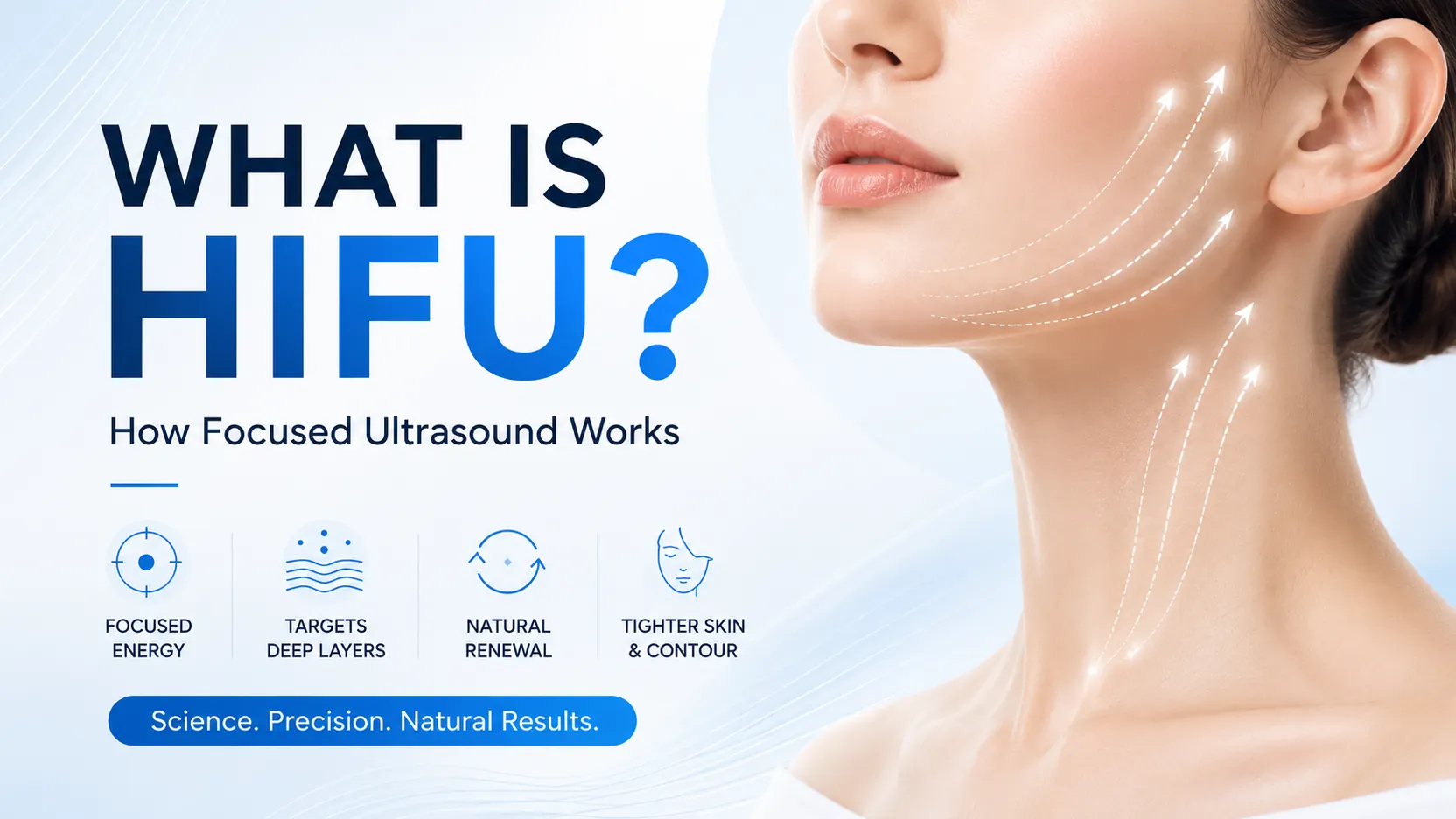
HIFU stands for High-Intensity Focused Ultrasound. In simple terms, it concentrates ultrasound energy within a small area of tissue so the main effect occurs at a planned focal zone. Medical HIFU uses this principle to treat specific diseases. Aesthetic HIFU applies it to non-surgical skin tightening and related aesthetic uses.
The central point is straightforward: HIFU describes a category of focused ultrasound technology. Each HIFU system has its own intended use, transducer design, focal depth, energy controls, and operating method.
This guide explains how HIFU works, where medical and aesthetic HIFU are used, what clinical research shows, what treatment feels like, which risks matter, and how an aesthetic HIFU system delivers energy. If you are considering treatment, it will also help you ask more useful questions during a consultation.
What is HIFU?
HIFU works by bringing multiple ultrasound waves together within a small area beneath the skin or inside another tissue. Energy remains more dispersed along the path and becomes concentrated at the designed focal zone. A magnifying glass focusing light offers a simple analogy, although HIFU is transmitting sound rather than light. The Mayo Clinic overview of HIFU describes the same basic idea: ultrasound beams converge at a target to create the intended tissue effect.
Ultrasound is non-ionizing energy and works through a different physical mechanism from X-rays. Therapeutic ultrasound still creates a real biological effect in tissue. For that reason, focal zone placement, energy delivery, and the surrounding nerves, blood vessels, and other structures all matter.
Diagnostic ultrasound and HIFU also perform different jobs. A diagnostic scan sends lower-energy sound waves into the body and uses returning echoes to create an image. HIFU delivers focused therapeutic energy to a target. Some medical HIFU platforms combine treatment with MRI or ultrasound for planning and monitoring. Real-time visualization on an aesthetic HIFU system varies by platform.
How does HIFU work?
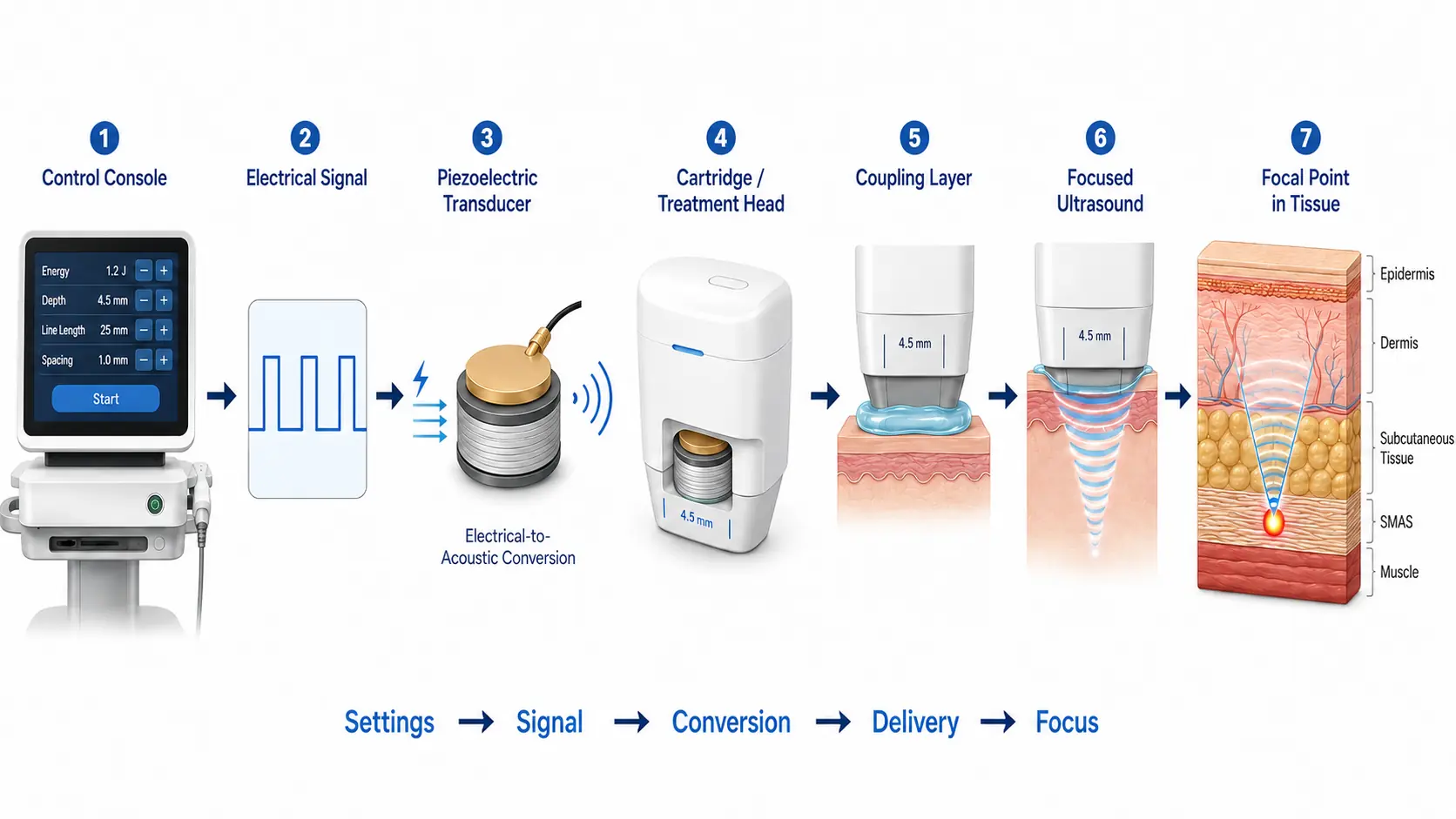
Several steps occur between pressing the start button and delivering energy to a focal zone. The control console creates and manages an electrical signal. The handpiece carries the treatment components. The transducer converts electrical energy into ultrasound. The cartridge or treatment head shapes the beam. Coupling gel helps sound enter the skin. The ultrasound energy then converges at the planned focal zone within tissue. Each step affects the final delivery.
These component names are easy to confuse. The transducer performs the electrical-to-acoustic conversion. The handpiece is the assembly held and positioned during treatment. A cartridge or treatment head is a system-specific component that helps create a particular beam pattern and focal depth. Platforms use different component designs, so compatibility checks rely on part numbers, connectors, and system recognition rather than appearance alone.
The focal zone, heat, and tissue response
When tissue absorbs ultrasound energy, the focal zone can heat and form a small treatment area. Focused ultrasound can also produce mechanical effects under specific acoustic conditions. The balance between thermal and mechanical effects is shaped by the HIFU system, frequency, intensity, pulse pattern, exposure time, focal geometry, and tissue properties.
Because the energy converges below the surface, aesthetic HIFU usually leaves the epidermis intact and requires no incision or needle. Safe delivery still requires accurate focal zone placement, a compatible treatment head, stable contact, and suitable energy settings.
Why coupling matters
Different tissues have different acoustic properties. Ultrasound can be absorbed, reflected, scattered, or weakened as it travels. Even a small air gap between the treatment head and skin can interfere with transmission, which is why the procedure uses coupling gel or another medium specified for the HIFU system. In plain language, coupling gel creates a stable path for sound to enter the skin.
How does an aesthetic HIFU system deliver energy to the focal zone?
The general focusing principle becomes easier to understand when the HIFU system is broken into its main parts. A typical aesthetic platform includes a control console, signal circuitry, a handpiece, a transducer, a cartridge or treatment head, coupling gel, and control software.
| Component | Main role | What to check |
|---|---|---|
| Control console and signal circuitry | Creates and manages the electrical signal that drives the transducer | Available modes, treatment head recognition, error messages, and output controls |
| Handpiece | Holds the treatment components and allows stable positioning against the skin | Connector, cable, housing, connection status, and handling stability |
| Transducer | Converts electrical energy into ultrasound and helps form the focused beam | Frequency, aperture, focal geometry, and HIFU system compatibility |
| Cartridge or treatment head | Provides a system-specific focal depth and firing pattern | Model, labeled focal depth, identification data, service life, and compatibility |
| Coupling gel | Reduces air between the treatment head and skin to create a sound path | Correct medium, full coverage, and consistent contact |
| Software and safety controls | Manages modes, recognizes components, and records status when supported | Software version, compatibility list, alerts, and record functions |
When we manufacture and inspect aesthetic HIFU systems at FotroHIFU, we check the electrical signal, cable and handpiece connections, transducer response, cartridge recognition, and firing status as one continuous chain. A fault at any point can change delivery consistency, so each item is verified before the unit moves to the next inspection stage.
The treatment head makes this pathway easier to see. Its control board manages the signal, the transducer module performs the electrical-to-acoustic conversion, and the acoustic matching layer and output window sit along the path that carries sound toward the skin.
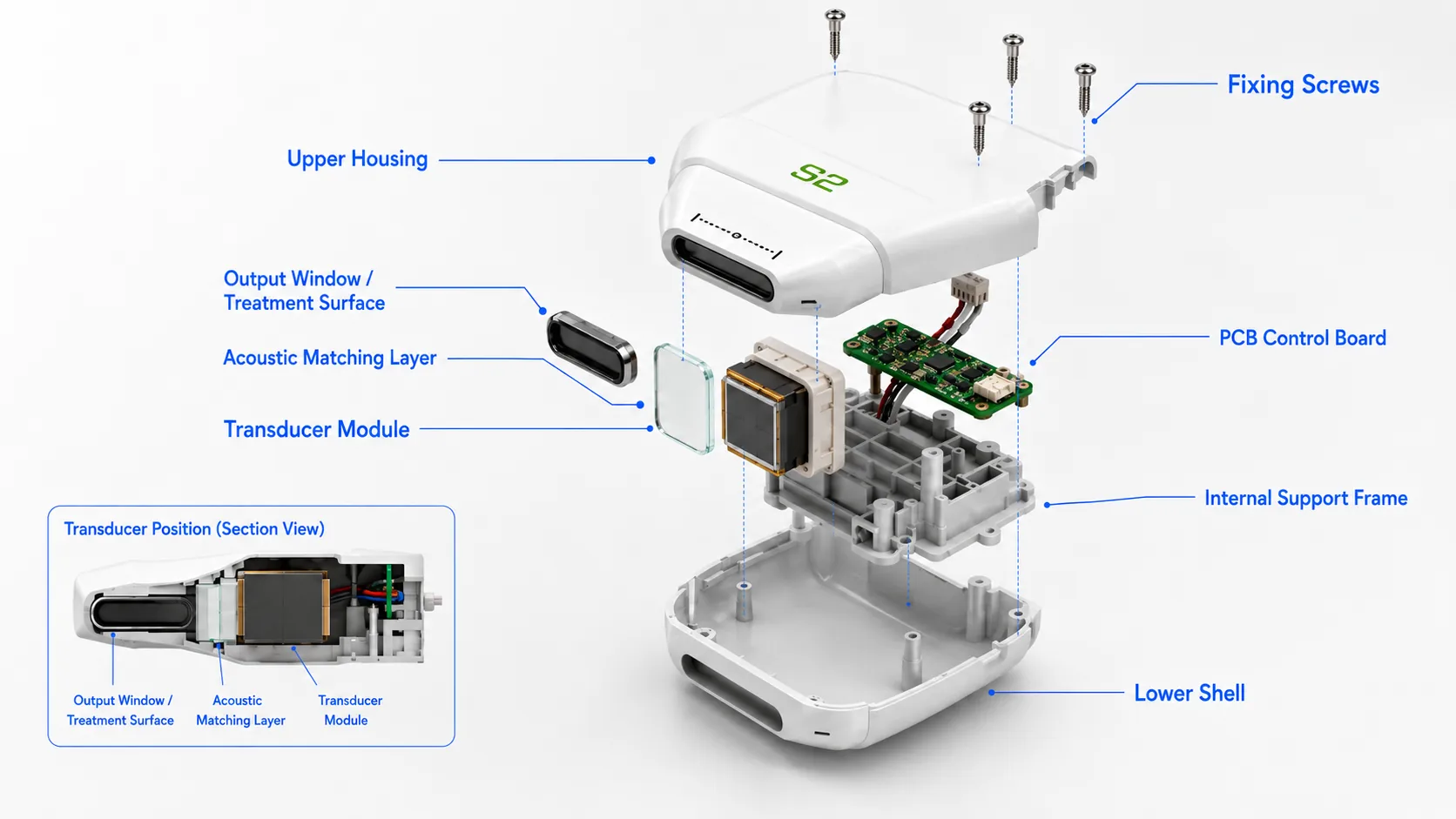
After an operator selects an input on the screen, the HIFU system still has to generate the signal, convert it into ultrasound, shape the beam, maintain coupling, and transmit energy through tissue. The number shown on the display is the starting point for that chain.
Engineering note 1: Match settings to the current platform. Settings should be paired with the control console, treatment head, firing mode, and treatment area as one system. A platform-specific settings record can document the selected mode, compatible treatment head, and treated area for each procedure.
What can aesthetic HIFU improve, and what is outside its main scope?
Aesthetic HIFU is most often discussed in relation to skin and soft-tissue laxity. The brow, lower face, jawline, and neck are common areas in published research. Still, a concern such as a poorly defined jawline can come from several sources. Identifying the relevant tissue layer makes the treatment choice more useful.
Practical check: Define the concern before discussing a device. A poorly defined jawline can reflect skin laxity, localized fat, volume loss, skeletal support, or a combination of factors. Separating those causes makes it easier to identify the target layer, choose an appropriate treatment head, and recognize concerns that call for another technology.
The most relevant target: mild to moderate skin laxity
For someone with mild to moderate skin laxity who accepts gradual change, aesthetic HIFU can be considered as a non-surgical option. Energy at the focal zone creates small treatment areas, produces local contraction, and starts a tissue remodeling response. The visible result is generally a gradual change in tightness or contour rather than the more substantial tissue repositioning achieved through surgery.
Collagen participates in tissue remodeling, but the phrase “stimulates collagen” does not tell anyone how much visible improvement to expect. Baseline laxity, tissue thickness, treatment area, focal depth selection, energy delivery, and individual response all influence the result. More pronounced sagging generally calls for a greater structural change.
Concerns better addressed by other treatments
Pigment, visible vessels, rough surface texture, acne scars, and dynamic expression lines involve different treatment targets. Pronounced volume loss relates to tissue volume and support. Localized fat requires a body-contouring approach with an intended use and evidence for that area. Lasers, light-based treatments, injectables, surgery, and other options address these concerns through different mechanisms.
Some HIFU systems also have body-contouring uses. Evidence for facial tightening and evidence for body contouring should be read separately. The relevant study needs to identify the platform, body area, and outcome being measured.
How to judge whether a visible change is meaningful
Before-and-after photographs are most useful when the lighting, camera position, facial angle, and expression remain consistent. A small photography change can make a result look larger than it is. Professional ratings, the person’s own experience, and objective measurements can also be recorded separately. Adding the HIFU system, treatment area, assessment method, and follow-up point helps distinguish an early change from later tissue remodeling.
What is the difference between medical and aesthetic HIFU?
Medical HIFU and aesthetic HIFU both focus ultrasound within tissue, but they are designed to solve different problems. Medical HIFU treats a diagnosed disease by ablating or otherwise changing a defined lesion or anatomical target. Aesthetic HIFU creates controlled treatment zones for a specified aesthetic use. That difference changes the operator, equipment design, planning process, evidence, and regulatory pathway.
| Comparison | Medical HIFU | Aesthetic HIFU |
|---|---|---|
| Purpose | Treats a diagnosed disease or creates a defined therapeutic tissue effect | Addresses skin laxity or another aesthetic concern within the HIFU system’s labeled or documented use |
| Target and endpoint | A defined lesion, organ, or disease-related tissue; the endpoint is tied to a specific condition and treatment plan | A selected dermal, subcutaneous, or soft-tissue location; the endpoint is tightening, contour change, or another system-specific aesthetic outcome |
| HIFU system design | Can combine a treatment console with imaging or navigation, planning software, positioning, tracking, cooling, and monitoring | Commonly includes a control console, handpiece, transducer, cartridge or treatment head, coupling gel, and control software; some systems include visualization |
| Planning and imaging | Often uses MRI or ultrasound for target planning, guidance, and monitoring, with the method tied to the indication and platform | Can include ultrasound visualization or use planned treatment areas, treatment heads, and placement protocols without real-time imaging |
| Typical setting and operator | Usually performed in a hospital or medical facility by a clinical team with relevant specialty privileges and platform training | Performed in a setting permitted for the procedure by an operator whose scope, training, and facility requirements cover the treatment |
| Evidence and regulation | Evidence and market authorization correspond to the disease, target, platform, protocol, and clinical endpoint | Evidence and market authorization correspond to the specific HIFU system, aesthetic use, anatomical area, population, and assessment endpoint |
Medical platforms often include more complex imaging, planning, anesthesia, or patient-monitoring functions. Aesthetic platforms are usually more compact but still have a defined intended use and specific operating requirements. Manufacturer training explains how to operate a HIFU system. Professional licensure and facility rules define who can perform the procedure.
In the United States, the FDA classification record for aesthetic focused ultrasound devices lists product code OHV, Class II, and the 510(k) pathway. The FDA 510(k) record K260618 applies to a named HIFU system and a reviewed submission. FDA-cleared claims should identify the corresponding system and intended use. Other markets use their own device classification and conformity assessment requirements.
What happens during treatment, and when do results appear?
A well-run aesthetic HIFU treatment starts with a consultation. The professional should ask what you want to improve, review your medical history and medications, discuss previous procedures, and examine the current condition of the treatment area. The procedure itself usually includes cleansing the skin, applying coupling gel, mapping the area, selecting a compatible treatment head, and delivering energy in the permitted mode.
As each point or treatment line fires, you can feel warmth, tingling, prickling, tenderness, or a deeper aching sensation. The intensity varies with the area, HIFU system, settings, and personal sensitivity. A sudden increase in pain should trigger an immediate pause and equipment and treatment-area check.
Visible downtime is usually limited, although temporary redness, swelling, tenderness, tingling, altered sensation, or a bruised feeling under the skin can occur. Some people notice an early sense of tightness. More established visible change develops gradually as tissue remodeling continues, so a planned follow-up is more informative than an assessment immediately after treatment.
What does the clinical evidence show?
The clearest answer is that aesthetic HIFU has produced measurable improvement in selected study populations. Research also shows substantial variation between individuals, treatment protocols, and HIFU systems. The evidence supports the technology and selected uses, while individual outcomes still vary across people and platforms.
Research supports improvement in selected patients
A 2025 systematic review of aesthetic HIFU brought together 45 clinical trials and cohort studies. Across the included literature, multiple studies reported improvement in measures related to skin tightening or body contouring. This shows that aesthetic HIFU has been studied in people as well as explained through its physical mechanism.
The word “improvement” still needs context. In the 2023 systematic review of microfocused ultrasound for facial skin tightening, professional evaluators reported improvement more often than study participants reported it themselves. Professional grading, standardized photographs, objective measurements, and personal satisfaction capture related but different outcomes.
Why study results vary
The studies did not use one identical treatment. They varied in platform, transducer frequency, focal depth, energy, treatment area, participant characteristics, assessment method, and follow-up period. Some studies had small samples. Every study included in the 2023 review enrolled women, and the 2025 review called for more data across skin tones and longer follow-up.
Safety belongs in the same evidence discussion. A 2025 review of aesthetic HIFU complications and risks found that most reported reactions were mild and temporary, while also documenting a small number of serious complications. A complete consultation should cover common reactions, warning signs, and the action to take if an unexpected symptom appears.
Is HIFU safe? Side effects, risks, and suitability
Safety starts before treatment and continues through the procedure and follow-up. Health screening, anatomical planning, treatment head selection, stable coupling, and clear stop rules all play a role. Common temporary reactions include redness or a temporary color change, swelling, tenderness, tingling, short-term altered sensation, and occasional bruising or purpura. Published studies generally describe these reactions as mild and able to resolve on their own.
Safety action: Turn warning signs into a stop rule. A sudden increase in pain or any visual symptom should stop energy delivery immediately and trigger a check of the treatment head, coupling, and treatment area. Persistent pain, weakness, blistering, visual symptoms, or marked asymmetry should be referred for medical evaluation, with the HIFU system, treatment head, settings, and location documented.
Burns, fat atrophy, nerve-related symptoms, eye injury, and vascular injury are less common but more serious. The eye area and locations near facial nerve branches and blood vessels require careful anatomical planning before treatment.
Persistent pain, visual symptoms, weakness, blistering, marked asymmetry, or another concerning change should be evaluated promptly by a qualified medical professional.
Treatment should be postponed for active infection or inflammation in the area, pregnancy, relevant implanted medical devices or metal, bleeding risk, unstable health conditions, impaired healing, or a recent procedure in the same area until an appropriate medical screening is complete. The consultation should document medical history, medications, implants, recent procedures, and the planned treatment area.
Before firing begins, the operator should confirm the focal depth, treatment head condition, skin contact, coupling coverage, and anatomical markings. The pre-treatment check should also cover system self-tests, treatment head recognition, connection status, and error messages, with the result recorded.
Why are aesthetic HIFU systems different?
After learning the basic principle, the next questions are usually practical: How do HIFU systems differ? What is the difference between 7D and 12D? Can two treatment heads with the same labeled focal depth be interchanged? A useful comparison breaks those questions into six areas: focal target, component compatibility, firing pattern, commercial labels, maintenance, and training.
Different platforms create their own working profile through transducer design, focal geometry, firing modes, visualization, output controls, component recognition, and intended use. These are the details that make a comparison meaningful.
Focal depth sets the target location
A shallower focal depth places the focal zone closer to the surface. A deeper focal depth places it farther below the surface. Treatment area, tissue thickness, anatomy, and intended use guide focal depth selection. Energy control, beam shape, and output consistency are separate performance dimensions.
Two cartridges with the same labeled focal depth still need to be matched for frequency, focal geometry, connector, software recognition, pulse control, and control-console compatibility. Part numbers and compatibility lists provide a practical way to manage HIFU accessories for a specific platform.
Engineering note 2: Compatibility comes from the full component record. A useful check follows this order: HIFU system model, treatment head part number, connector, software recognition, frequency, and focal geometry. Recording all six items reduces mismatches and simplifies cartridge inventory.
Dots, treatment lines, multi-line delivery, and “D” labels
A HIFU system can create one focal zone at a time, move a series of focal zones into a treatment line, or use a treatment head that forms multiple parallel lines. This distribution changes coverage and treatment pace. Clinical performance also involves focal design, energy, treatment area, protocol, and candidate selection.
Names such as 4D, 7D, 12D, and 22D are commonly used as product-series or commercial labels. When comparing professional aesthetic HIFU systems, look at the transducer and treatment head information, focal depth, firing method, output control, visualization, maintenance, training, and intended use.
Engineering note 3: Convert the “D” label into verifiable specifications. Break the product name into treatment head count, focal depths, firing modes, coverage per pass, and output controls. Those details provide a clearer basis for comparing operation and maintenance.
How does HIFU compare with other skin-tightening treatments?
Start with the concern you want to address, then identify the relevant tissue layer. Once the target is clear, expected change, risk, invasiveness, and recovery time become easier to compare.
| Option | Energy or method | Common target | Main difference from HIFU |
|---|---|---|---|
| Surgical facelift | Incisions and surgical tissue repositioning | More pronounced structural lifting | Produces a more direct structural change with greater invasiveness, risk, and recovery |
| Radiofrequency | Electrical energy converted to heat | System-specific skin or subcutaneous targets | Uses radiofrequency energy; HIFU uses focused ultrasound |
| Radiofrequency microneedling | Microneedles combined with radiofrequency | Texture, scars, and some laxity concerns | Needles enter the skin and release radiofrequency energy at a set depth |
| Laser | Light at a selected wavelength | Resurfacing, pigment, visible vessels, or another chromophore-specific target | Uses light and tissue-specific optical absorption |
| HIFU | Focused ultrasound | A planned focal zone within the HIFU system’s intended use | Concentrates sound energy at a selected depth without needles |
Each treatment addresses a different energy target or structural problem. Light-based treatments are often selected for pigment or visible vessels. Technologies that heat deeper tissue can address specific laxity concerns. Pronounced structural sagging belongs in a surgical evaluation. The treatment choice starts with the actual concern and tissue layer.
Conclusion
HIFU can be understood simply as a way to concentrate ultrasound energy at a selected target inside the body. Medical HIFU is mainly used for defined lesions or tissue targets, including some prostate cancers, uterine fibroids, and essential tremor. Aesthetic HIFU applies the same focusing principle to the skin and soft tissue to improve selected cases of mild to moderate skin laxity, with tightening and contour changes appearing gradually as tissue remodeling develops.
The core physics is the same, but the applications are different. Medical HIFU emphasizes lesion targeting, treatment planning, and clinical outcomes. Aesthetic HIFU emphasizes the treatment area, focal depth, and tissue layer being addressed. The aesthetic HIFU system is the tool that carries out the process, with the control console, transducer, and treatment head working together to place energy at the planned location.
The key to understanding HIFU is knowing where the energy is going, what problem it is intended to address, and what type of change the treatment is designed to produce.
FAQ
What does HIFU stand for?
HIFU stands for High-Intensity Focused Ultrasound. It describes a technology that concentrates ultrasound energy at a selected location within tissue.
Is HIFU the same as diagnostic ultrasound?
No. Diagnostic ultrasound receives returning echoes to create an image. HIFU delivers focused therapeutic energy to produce a tissue effect. Some medical platforms use ultrasound or MRI for guidance, but the imaging function and treatment beam perform different jobs.
Is HIFU a medical treatment or an aesthetic procedure?
Both uses exist. Medical HIFU targets a diagnosed disease or defined tissue target. Aesthetic HIFU is used for a specified aesthetic purpose. The HIFU systems, treatment goals, operators, evidence, and regulatory requirements differ between the two settings.
How does a HIFU system work?
The control console produces an electrical signal, the transducer converts it into ultrasound, the treatment head shapes the beam, and coupling gel helps sound enter the skin. The energy then converges at a designed focal zone. The operator manages screening, treatment head selection, placement, and contact.
Does HIFU hurt?
Treatment can feel warm, prickly, tingly, tender, or achy at a deeper level. Sensation varies with the area, HIFU system, settings, and personal sensitivity. The consultation should explain the expected range of sensation and the symptoms that trigger a pause.
How long do HIFU results take to appear?
Visible change usually develops gradually as tissue remodeling continues. A consultation can set an observation window and follow-up point tied to the HIFU system, treatment area, and protocol being used.
How much does HIFU cost?
Pricing varies by location, treatment area, HIFU system, operator qualifications, coverage, and follow-up plan. When comparing quotes, ask which system will be used, which areas are included, who will perform the treatment, and whether follow-up is included.
Can HIFU replace a facelift?
HIFU offers gradual, non-surgical tightening. A surgical facelift can create more pronounced tissue repositioning. People with mild to moderate skin laxity who accept a more limited change are closer to the typical aesthetic HIFU treatment profile.
Are all HIFU systems the same?
No. Platforms differ in transducers, focal depths, treatment heads, firing patterns, visualization, software, output controls, compatible components, and intended uses. Labels such as 7D or 12D become more useful when translated into these verifiable details.
References
- Mayo Clinic Staff. High-intensity focused ultrasound (HIFU). Mayo Clinic. Medical review date: February 1, 2026.
- Haykal D, Sattler S, Verner I, Madhumita M, Cartier H. A Systematic Review of High-Intensity Focused Ultrasound in Skin Tightening and Body Contouring. Aesthetic Surgery Journal. 2025;45(7):690-698. DOI: 10.1093/asj/sjaf053.
- Biskanaki F, Tertipi N, Sfyri E, Kefala V, Rallis E. Complications and Risks of High-Intensity Focused Ultrasound (HIFU) in Esthetic Procedures: A Review. Applied Sciences. 2025;15(9):4958.
- Contini M, Hollander MHJ, Vissink A, et al. A Systematic Review of the Efficacy of Microfocused Ultrasound for Facial Skin Tightening. International Journal of Environmental Research and Public Health. 2023;20(2):1522. PMID: 36674277.
- U.S. Food and Drug Administration. Product Classification: Focused Ultrasound for Tissue Heat or Mechanical Cellular Disruption. Product code OHV; Class II; 510(k). Page updated August 24, 2026.
- U.S. Food and Drug Administration. 510(k) Premarket Notification K260618. Decision date: May 21, 2026; page updated July 6, 2026.