

When a client points to their abdomen and asks, “Can you make this area smaller?”, the clinic first needs to understand the concern: local fat, loose skin, or a combination of both. The questions that follow are just as practical. Can the client return to work after treatment? How many visits will they need, when will changes become visible, and what will the full course cost? These questions also shape the equipment a clinic chooses when adding a service.
HIFU and ultrasonic cavitation both use ultrasound energy and appear in descriptions of tightening or body-contouring services, making them natural candidates for comparison. Their use of ultrasound, target tissues and treatment schedules differ. Some cavitation consoles also combine radiofrequency or vacuum functions, adding another layer to the relationship between a machine’s name and what it actually does.
For a clinic weighing HIFU vs cavitation machine options, understanding these differences helps connect equipment functions to specific client needs. The comparison starts with how the two technologies work, then examines treatment areas, suitable clients, recovery, session schedules and costs.
What Is a HIFU Machine?
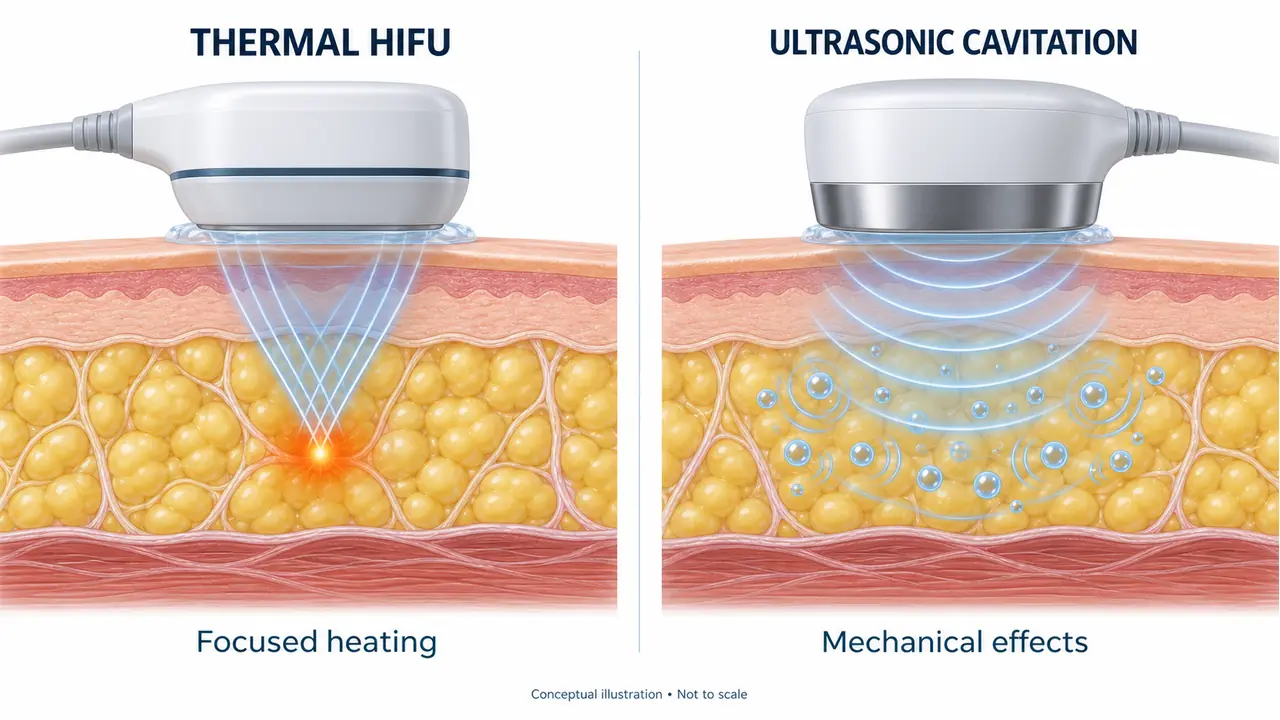
A HIFU machine delivers high-intensity focused ultrasound through a transducer, the component that converts electrical energy into sound waves. Those waves converge beneath the skin. At the focal zone, the system concentrates energy into a small target rather than treating every tissue layer equally.
In aesthetic applications, thermal focused ultrasound creates controlled heating at selected depths. Skin-tightening treatments use this response to stimulate tissue remodeling. Body fat-reduction systems target subcutaneous adipose tissue, the fat beneath the skin. These applications require different treatment targets and applicators.
A facial HIFU study used focal depths of 3.0 and 4.5 mm to evaluate facial wrinkles and laxity. These are examples from a facial protocol, not body-fat treatment depths. The treatment head and target tissue determine the application.
Microfocused ultrasound with visualization, abbreviated MFU-V, belongs to the wider focused-ultrasound field. Ultherapy is a named example. Its imaging and published treatment information belong to that platform; a generic HIFU console does not automatically include visualization.
The HIFU technology guide explains the technology and its aesthetic uses in more detail.
What Is an Ultrasonic Cavitation Machine?
An ultrasonic cavitation machine delivers ultrasound through a body-treatment handpiece. In this comparison, cavitation refers to the low-frequency body-contouring category sold to clinics and aesthetic practices.
Cavitation is a physical effect: changing acoustic pressure drives bubble activity in a fluid environment. At suitable exposure conditions, that activity creates mechanical stress in tissue. A human adipose-tissue study examined ultrasound-induced cavitation with the Med2Contour system and observed changes in fat-cell size and structure. The effect is different from the deliberate focal heating used in thermal HIFU.
“Focused ultrasound” and “cavitation” are not mutually exclusive scientific terms. Some ultrasound systems focus energy while producing mechanical cavitation. For a practical machine comparison, the useful distinction is the system’s intended thermal or mechanical effect, its applicator and its treatment target.
RF, vacuum and EMS are separate functions on a combined console. Radiofrequency uses electrical energy for tissue heating; vacuum mechanically manipulates tissue; EMS stimulates muscle contraction. A tightening result from an RF-plus-cavitation treatment cannot be assigned entirely to the cavitation handpiece.
What Are the Main Differences Between HIFU and Cavitation?
The comparison below moves from the way energy works to the treatment it supports and then to the machine used to deliver it.
| Comparison dimension | HIFU machine | Ultrasonic cavitation machine |
|---|---|---|
| Energy delivery | Concentrates ultrasound at selected focal zones | Uses a cavitation handpiece to deliver ultrasound across a treatment area |
| Intended tissue effect | Thermal aesthetic systems produce controlled focal heating | Cavitation-based systems emphasize mechanical effects from acoustic pressure |
| Main target | Skin-supporting tissue for tightening, or subcutaneous fat in a body fat-reduction system | Local subcutaneous fat in a body-contouring application |
| Depth control | Applicator design determines focal depth and geometry | Frequency, acoustic output and handpiece design together influence the treated field |
| Treatment goal | Lifting, tightening or local fat reduction according to the platform | Local contour and circumference improvement; additional RF addresses a separate goal |
| Face versus body | Facial and body applications use appropriate configurations | The body cavitation handpiece is the comparison here; a separate facial attachment has its own use |
| Delivery workflow | Operator plans treatment zones and places energy at the selected depth | Operator maintains contact and covers the prescribed area with the handpiece |
| Machine configuration | Console with compatible treatment heads or cartridges; visualization on specified systems | Console with a cavitation handpiece, sometimes combined with RF, vacuum or EMS |
| Ongoing equipment cost | Cartridge replacement or usage limits where the model employs them | Contact medium, handpiece maintenance and replacement; costs for additional functions |
| Service structure | A focused-ultrasound procedure with a planned review of results | An area-based body treatment that can be offered as a course |
A frequency label such as “40K” describes one parameter. It does not specify focal depth, acoustic dose or the complete treatment effect. Likewise, the number of HIFU cartridges describes the available configuration rather than the quality of every treatment.
Which Treatment Areas and Concerns Can Each Address?
Face, neck and skin laxity
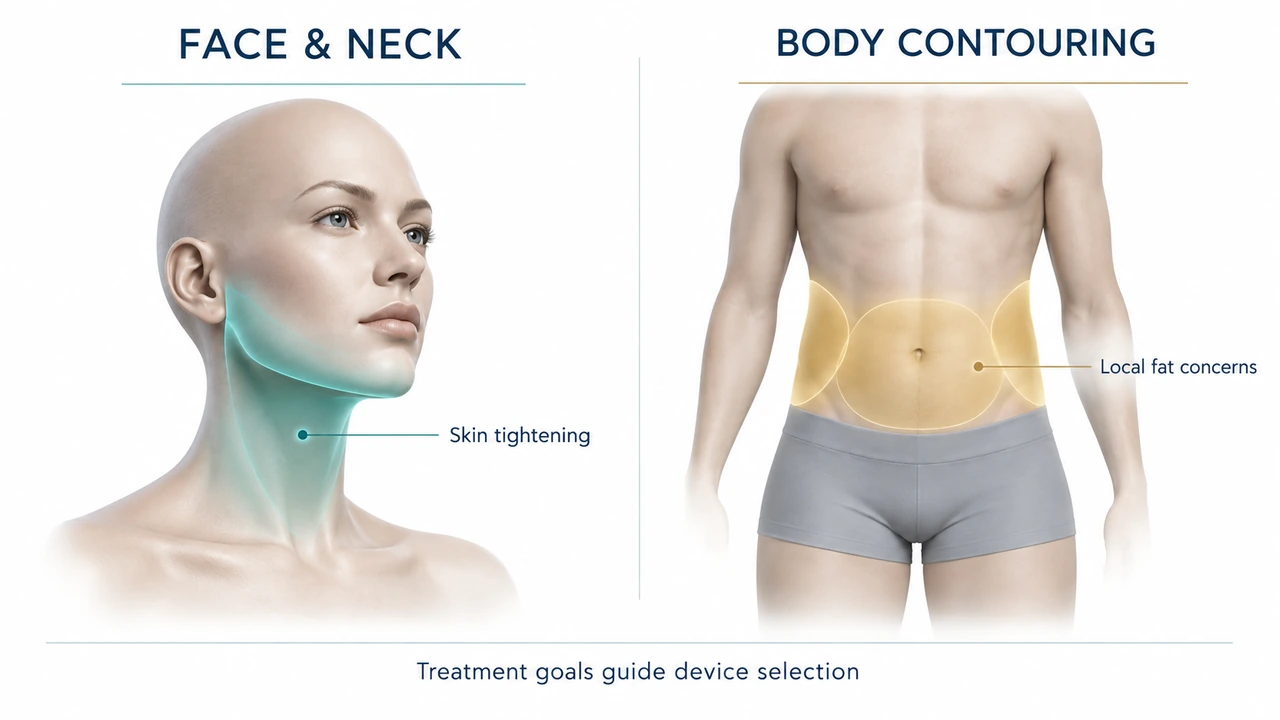
The American Society for Dermatologic Surgery (ASDS) describes ultrasound skin tightening as a treatment for moderately loose skin, with applications on the brow, neck and under the chin. Focused ultrasound stimulates collagen formation beneath the surface, with lifting and toning developing over time.
A body cavitation handpiece does not offer an equivalent facial lifting service. If a multi-function console includes facial RF, that is a comparison between HIFU and RF, with its own treatment target and evidence.
“Double chin” also needs a more precise description. Loose under-chin skin and excess under-chin fat call for different assessments. A skin-lifting indication alone does not establish a fat-reduction indication.
Abdomen, flanks and other body areas
The abdomen and flanks are useful areas for a like-for-like body-contouring comparison. Body HIFU research and ultrasound cavitation research both include abdominal applications. Treatment of the thighs, arms or other regions requires an applicator and protocol suited to that anatomy.
Skin tightening on the abdomen and abdominal fat reduction have different treatment goals. The consultation should establish which tissue change would address the client’s concern.
Match the treatment goal
In its report on Mark Jewell’s research, the American Society of Plastic Surgeons describes HIFU treatment of abdominal and flank fat in nonobese patients. Waist circumference was an outcome measure. This gives the clinic a specific comparison target: evaluate local fat reduction separately from improvement in loose skin.
Cellulite, muscle definition and overall weight
For dimpled skin, separate the desired change in surface texture from a reduction in fat thickness. A circumference result alone does not establish an improvement in cellulite. Similarly, ultrasound body contouring does not provide the muscle-contraction function of an EMS attachment.
Neither option should be presented as a solution for overall weight loss. A clinic should identify a local contouring or tightening goal and measure the outcome that matches it.
Who Is a Suitable Candidate?
Clients whose main concern is skin laxity
A client with mild to moderate laxity and an interest in gradual tightening is a more relevant starting point for focused-ultrasound assessment than someone seeking a large reduction in body weight. The Ultherapy candidate guidance emphasizes skin quality and mild to moderate laxity rather than a fixed age threshold.
This distinction matters in consultation. Age alone does not describe tissue thickness, degree of laxity or the change a client expects.
Assess the skin first
The American Academy of Dermatology’s skin-tightening guidance highlights a small amount of sagging skin and a healthy, maintained weight among factors associated with better results. It recommends assessment by a board-certified dermatologist. A consultation should therefore establish the degree of laxity and realistic treatment goals before selecting a procedure.
Clients seeking a smaller local fat deposit
Body-contouring assessment should consider the location and thickness of subcutaneous fat, skin condition and the client’s goal. A randomized body HIFU trial enrolled nonobese adults with at least 2.5 cm of abdominal subcutaneous fat. That threshold belonged to the study device and protocol.
A separate low-frequency ultrasound study examined 28 normal-weight women. Together, these examples show why a local fat deposit can be relevant even when a person is not seeking substantial weight loss. They do not establish one BMI or fat-thickness cutoff for all machines.
Clients whose schedule and expectations match the course
Attendance is part of suitability. A client who cannot return for repeated appointments needs a different discussion from one who prefers shorter visits spread over several weeks. Someone expecting an immediate transformation before an event also needs a realistic explanation of when the chosen treatment will be assessed.
The clinic should settle these expectations before selecting a package. Otherwise, a suitable technology can still become an unsuitable service plan.
Manchester, UK: Choosing a Facial Clinic’s First Device
A boutique facial clinic in Manchester wanted to add a device-based service. Existing clients were asking about jawline and neck laxity, but the owner was weighing HIFU against cavitation. The budget covered one initial purchase, and the treatment room still needed to accommodate the clinic’s daily facial appointments.
We separated enquiries into face-and-neck tightening and local body contouring, then reviewed the service menu, room layout and training needs. That analysis put face-and-neck demand first, so we shortlisted UltraLift SD Compact for assessment. The proposed setup used its folding desktop format, a configuration selected for the planned facial services, and training focused on client assessment, handpiece selection and operating procedures. Body services were left for a later expansion, directing the first investment toward an identified service need.
How Do Treatment Time, Session Count and Results Compare?
How long is one appointment?
Treatment time covers more than energy delivery. Consultation, photographs, marking, positioning, cleaning and any additional modality also occupy the room.
Ultherapy’s official treatment FAQ describes approximately 30–90 minutes for its treatment, according to the area. It also describes results developing over two to three months after a single treatment and an immediate return to usual activities under practitioner instructions.
For body cavitation, the London clinic examples in the pricing section list 20-minute sessions. Their HIFU body appointments are listed at 40 or 60 minutes. These are useful booking examples; the treatment area and included work determine whether they match another clinic’s schedule.
How many sessions are needed, and how far apart?
A single-treatment focused-ultrasound service and a repeated cavitation course create different commitments. The low-frequency ultrasound study cited above used a 10-week program.
For an example of a current offered cavitation course, CoLaz’s treatment information describes six to twelve appointments at weekly intervals. This is that provider’s service schedule. The clinic delivering treatment must use the course supported for its own device.
Explain the proposed number of visits, spacing and review date together. “Six sessions” tells a client little about whether the course occupies three weeks or three months.
When should results be evaluated?
Tightening, fat thickness and circumference are different endpoints. They also require an appropriate review date.
Read the follow-up
The randomized body HIFU trial cited in the candidate section measured waist circumference at 12 weeks. Its higher-energy group showed a statistically significant reduction compared with sham treatment. For a useful treatment comparison, keep the device, treated area, outcome measure and follow-up time together when explaining a study result to clients.
For progress records, keep the body position, measurement location and photography consistent. Record weight changes and other treatments that could affect the comparison. A photo taken immediately after an appointment answers a different question from a review several weeks later.
How long do results last?
A follow-up period shows how long researchers observed the outcome. It does not automatically establish when the effect ends or when another treatment is needed.
The skin-aging process and later changes in body weight also influence appearance. Maintenance should therefore follow a reassessment of the original concern. Avoid turning the initial course into an automatic repeat schedule without checking whether that concern remains.
What Do Treatment and Recovery Feel Like?
Sensation during treatment
Focused-ultrasound delivery can produce heat or tingling, as described in the Ultherapy FAQ. The experience changes with the treated area and platform. Body HIFU safety data also report discomfort during the treatment process.
For cavitation services, the experience of the full appointment includes whichever functions are used. Adding RF adds a heating component; adding vacuum changes the mechanical sensation. The consent discussion should describe the actual treatment being offered.
Return to activities and visible recovery
Ultherapy describes a return to normal activities immediately after its treatment. In the facial study cited in the HIFU definition, reported redness, swelling and bruising resolved within two weeks. A 24-week body HIFU study also reported temporary discomfort, bruising and swelling. These observations help explain why an activity plan and an appearance-recovery plan can differ.
In a combined RF–cavitation trial, researchers reported no adverse events in the study groups. Its combined protocol provides limited information about another cavitation console used alone. A universal recovery duration would hide that difference.
The useful comparison is the expected reaction for the offered procedure: skin appearance, tenderness, activity restrictions and the point at which the clinic should review an unexpected response. Aftercare should follow the selected device and clinician’s plan.
Shared safety considerations
The FDA body-contouring guidance lists pain, redness, swelling, blisters, burns and nerve damage among possible ultrasound complications. It also identifies treatment-area wounds, compromised skin, active implants and metal under the skin as important exclusions or precautions.
Both services need screening and correct coupling between applicator and skin. Non-invasive body contouring is intended for local appearance changes; the FDA states that it does not treat obesity or provide the health benefits of weight loss.
How Much Does a Treatment Session or Course Cost?
A useful price comparison names the location, treated area, appointment duration and number of visits. The following examples come from Knightsbridge Advanced Beauty in London, in GBP, checked on 15 September 2026. The same provider was selected because it publishes both services.
| Publicly listed service | Appointment | Listed price |
|---|---|---|
| HIFU body, small area such as upper arms or knees | 40 minutes | £350 |
| HIFU body, large area such as abdomen or thighs | 60 minutes | £600 |
| Cavitation, standard rate shown in the package calculation | 20 minutes | £80 per session |
| Cavitation, six-session package | Six 20-minute visits | £384 total; £64 per visit |
The six-visit package shows why the lowest single-session price is only part of the decision. Its total charge is £384, while the listed small-area HIFU appointment is £350. The goals and coverage still need to match before judging value.
For the clinic, treatment revenue must also cover staff time, room use, consumables and follow-up. A shorter appointment at a lower price can require more total visits per client. A higher-priced procedure can occupy a longer booking and carry a different consumable cost.
How Do the Machines Differ in Daily Clinic Operation?
Treatment heads, workflow and staff skills
HIFU operation centers on selecting the appropriate treatment head and planning where focused energy is delivered. Cavitation operation centers on applicator contact and coverage across the prescribed region. Multi-function consoles add distinct RF, vacuum or EMS workflows.
Training therefore needs to match the function an operator will actually perform. Adding more handpieces also adds cleaning, storage, competency and maintenance tasks. The HIFU training guide provides a useful starting point for those training discussions.
Valencia, Spain: Why a Body-Contouring Center Prioritized Cavitation
A body-contouring center in Valencia already owned a separate RF machine and was considering HIFU to expand its menu. During the discussion, the owner described repeated enquiries about local abdominal and flank contouring, with little interest in facial lifting. Most clients lived nearby and could attend planned appointments. The service gap centered on those body-contouring requests.
We reviewed the requested areas, existing RF functions and available appointment slots together, then shifted the shortlist toward professional ultrasonic cavitation equipment. The proposed solution retained the RF machine and compared cavitation models with documented abdominal and flank applications. It also built treatment, cleaning and follow-up time into course scheduling, with training covering suitability screening, body-handpiece operation and records. The budget therefore prioritized the local-contouring service gap while avoiding extra spending on facial functions with limited demand.
Purchase price, consumables and maintenance
Compare complete working configurations: console, required handpieces, initial consumables, delivery, installation and training. A category-wide machine-price range would mix different configurations and support arrangements.
| Equipment cost or workflow | HIFU | Cavitation |
|---|---|---|
| Applicators | Match treatment heads to planned face or body services | Separate the cavitation handpiece from RF and other attachments |
| Consumables | Include cartridge replacement or shot limits when applicable | Include coupling medium and any disposable items |
| Wear and repair | Account for transducer, cartridge and handpiece service | Account for handpiece, cable and additional-modality service |
| Booking capacity | Allow for mapping, energy delivery and review | Allow for area coverage, additional functions and repeated appointments |
| Staff preparation | Anatomy, depth selection and treatment planning | Contact, coverage and training for each included function |
The important cost is what the clinic spends to deliver the planned service reliably. Warranty coverage for the console, treatment heads and shipping should be read separately because a failed applicator can stop bookings while the main console still works.
Regulatory status and operating requirements
Equipment status belongs to the exact manufacturer, model and intended use. In the United States, 510(k) clearance, De Novo authorization, PMA approval and registration/listing have different meanings. Registration or listing alone does not establish treatment clearance.
The clinic also needs to meet local requirements for who can operate the equipment and under what supervision. Supplier training and professional authorization answer different operational questions.
Which Machine Should Your Clinic Choose?
A clinic building a facial lifting or tightening service should assess the relevant HIFU configuration first. A body-contouring clinic should compare body HIFU and cavitation using the same target area, client profile and result measure.
Cavitation deserves consideration when a scheduled body-treatment course fits the intended service and clients can attend repeat visits. HIFU deserves consideration when the planned focused-ultrasound treatment matches the client concern and the clinic can support its appointment and applicator costs.
A clinic can offer both when they fill distinct roles. For a client with both laxity and a local fat deposit, the assessment should identify each concern separately. Combining procedures on one area requires a plan supported by the devices and treatment lead.
Use the service you intend to deliver—facial tightening, body tightening or local fat reduction—to compare the professional HIFU machine range. That gives the supplier a clear basis for discussing configuration, training and operating cost.
References & Sources
- Facial HIFU study: wrinkles and skin laxity
- Human tissue study of ultrasound-induced cavitation
- ASDS: ultrasound therapy for sagging skin
- ASPS: body HIFU research led by Mark L. Jewell
- Ultherapy UK: candidate guidance
- American Academy of Dermatology: firming sagging skin
- Randomized body HIFU trial, PMID 21701341
- Low-frequency ultrasound study, PMID 25196687
- Ultherapy: treatment FAQ
- CoLaz: ultrasound cavitation service and schedule
- HIFU safety follow-up, PMID 22942114
- Combined RF and ultrasound cavitation trial
- FDA: non-invasive body contouring
- Knightsbridge Advanced Beauty: HIFU body prices
- Knightsbridge Advanced Beauty: cavitation prices